
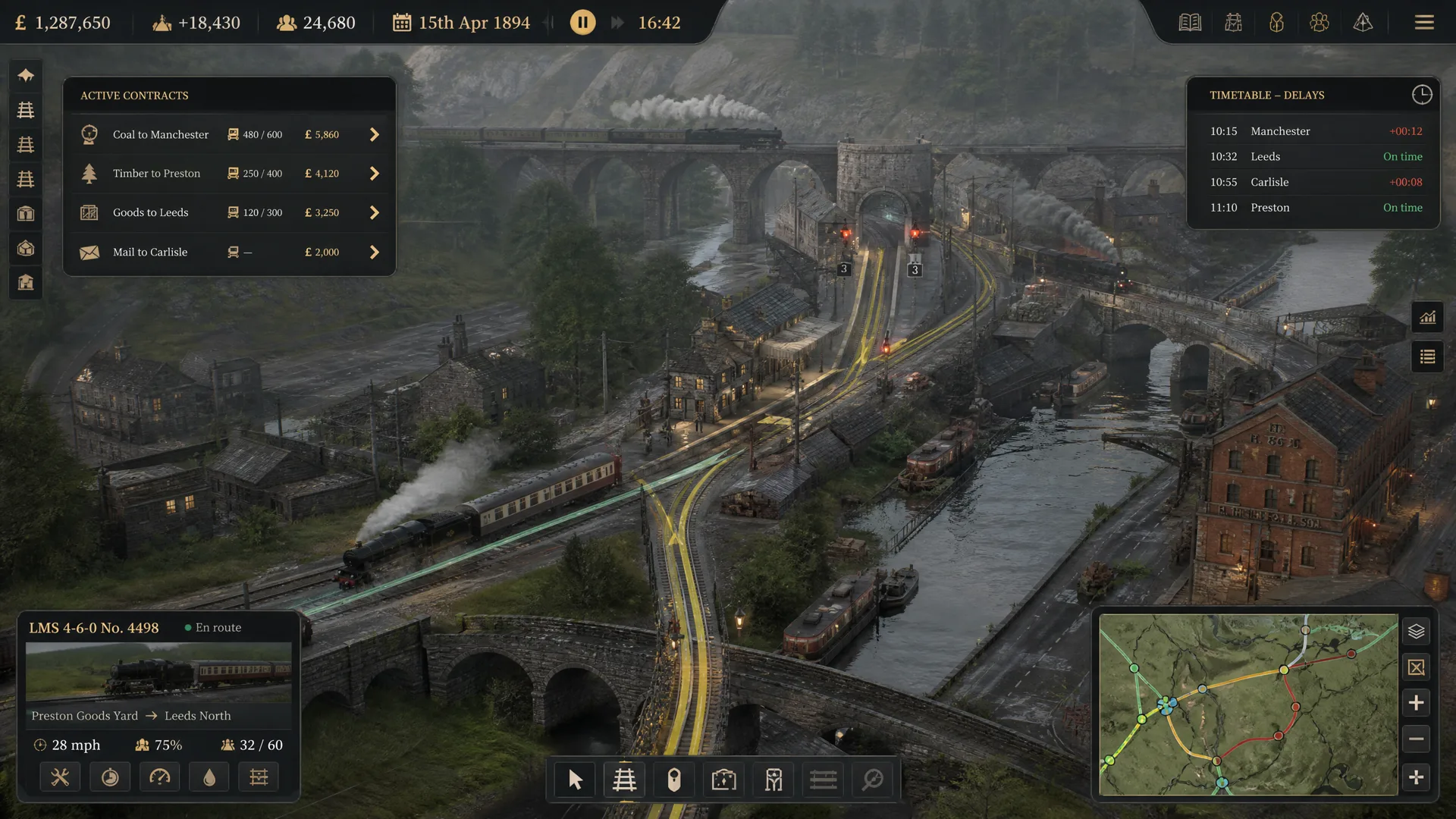
The Allure of the Rainy Northern Valley
There is a distinct, almost melancholic beauty to the setting of Calder Vale. From the moment the game boots up, you are greeted by an isometric view of a sprawling, rain-swept valley in northern England, its steep hillsides painted in muted greens and industrial greys. This is not a game of high-speed bullet trains or glamorous transcontinental journeys; rather, it is a meticulous simulation of regional railway logistics, deeply rooted in the gritty reality of British transport history. The rain falls relentlessly, pooling around the tracks and adding a tangible sense of atmosphere to the logistical puzzles that await.
As the newly appointed managing director of the valley's ailing rail network, your task is to bring order to chaos. The isometric perspective is not merely a stylistic choice but a necessary tool, offering a god-like view of the intricate web of tracks, stations, and industrial hubs that dot the landscape. The game wastes no time in handing over the reins, thrusting players into a complex ecosystem where every decision ripples across the valley.
Mastering the Route Overlays and Signals
The foundation of any successful railway network lies in its signalling, and Calder Vale treats this aspect with the reverence it deserves. The game introduces a sophisticated route overlay system, an essential tool for visualising the flow of traffic and identifying potential bottlenecks. Toggling these overlays transforms the picturesque valley into a schematic diagram of glowing lines and pulsing nodes, allowing players to dissect the network's efficiency with surgical precision.
Placing signals is an exercise in foresight and spatial awareness. The mechanics demand a deep understanding of block signalling principles, where the spacing of signals dictates the capacity and safety of a line. A poorly placed signal can lead to cascading delays, gridlock, or, in the worst-case scenario, a catastrophic collision. The game does not hold your hand here; it provides the tools and expects you to learn through trial and error, rewarding careful planning.
The Lifeblood of Industry: Cargo Contracts
While passenger services may garner the most public attention, it is the movement of freight that truly drives the economy of the valley. Calder Vale features a dynamic cargo contract system, requiring players to negotiate and fulfil logistical demands for various local industries. From transporting coal from the hillside collieries to delivering raw materials to the bustling textile mills, the freight network is a relentless engine of commerce.
These contracts are not simple point-to-point delivery tasks. They often involve complex, multi-stage supply chains, demanding careful allocation of rolling stock and meticulous route planning. Players must balance the lucrative payouts of heavy freight contracts against the wear and tear on the infrastructure and the potential disruption to other services.
Keeping Time: Passenger Services and Delays
If freight is the economic engine of Calder Vale, passenger services are its public face. The game implements a rigorous timetable mechanic, challenging players to maintain punctual services across a sprawling network of local stations and regional hubs. Passengers are unforgiving; delays lead to plummeting satisfaction ratings, which in turn affect ticket sales and your overall standing with the local authorities.
Creating a workable timetable is a daunting task. You must account for travel times, station dwell times, and the inevitable conflicts at busy junctions. The game provides a comprehensive scheduling interface, allowing for minute-by-minute adjustments to the roster. However, a timetable is only as good as its execution. Weather conditions, locomotive breakdowns, and signal failures can all throw a spanner in the works, requiring rapid, on-the-fly adjustments.
Overcoming the Geography: Viaducts and Bottlenecks
The rugged topography of the northern valley presents a formidable obstacle to railway expansion. The landscape is defined by steep gradients, deep ravines, and winding rivers, forcing players to make difficult engineering decisions. The most significant of these challenges is managing viaduct capacity. These massive, multi-arched structures are essential for crossing the valley floor, but they are hideously expensive to build and maintain, and they often serve as critical bottlenecks for the entire network.
Upgrading a viaduct from a single to a double track is a monumental undertaking, requiring a massive injection of capital and causing significant disruption to existing services. Players must carefully weigh the long-term benefits of increased capacity against the short-term financial and logistical pain. The game excels at forcing these difficult choices, ensuring that expansion is never a trivial matter of simply clicking and dragging tracks across the map.
Managing the Coffers: Budget and Depots
Beneath the romanticism of steam and steel lies the cold, hard reality of railway economics. Calder Vale features a stringent budgeting system that punishes profligacy and rewards prudent financial management. Every length of track, every signal, and every locomotive incurs a maintenance cost, constantly eating into your profit margins. Expanding the network too quickly is a surefire recipe for bankruptcy, necessitating a cautious, incremental approach to growth.
A crucial aspect of this financial balancing act is the management of depots. These facilities are essential for maintaining and refuelling your fleet, but they represent a significant capital investment. Placing depots strategically is vital for minimising empty running miles and ensuring that locomotives are always ready for service. The game demands that you think not just about where trains are going, but where they rest and recuperate.
- Fleet Standardisation: Operating a diverse range of locomotives increases maintenance costs.
- Preventative Maintenance: Scheduling regular downtime prevents costly on-line breakdowns.
- Strategic Borrowing: Utilising bank loans requires careful management of interest payments.
The Atmosphere of Industry: Presentation and Accessibility
Visually, Calder Vale is a triumph of art direction over sheer graphical fidelity. The isometric engine renders the valley with a meticulous attention to detail, from the billowing smoke of a struggling freight locomotive to the intricate brickwork of a Victorian station building. The dynamic weather system is particularly impressive; the ever-present rain streaks across the screen, turning the landscape into a muddy, industrial tableau that perfectly captures the mood of the setting.
The user interface, a critical component of any management simulator, is clean, intuitive, and highly functional. The route overlays and timetable screens are easy to read and manipulate, allowing players to access complex data without feeling overwhelmed. The controls are responsive, and the game offers a comprehensive suite of accessibility options, including scalable UI elements, colourblind modes for the signalling overlays, and pause-and-plan functionality.
Conclusion: The Valley Runs on Timetables
Calder Vale is a masterclass in focused, systemic design. By confining its scope to a single, challenging environment, it delivers a deeply engaging logistical simulation that rewards patience, planning, and precision. It eschews the sprawling, continent-spanning ambition of its peers in favour of a microscopic examination of regional railway management, and it is all the stronger for it. The interplay between the route overlays, the stringent timetables, and the unforgiving geography creates a compelling loop of problem-solving and optimisation.
It is not a game for those seeking instant gratification. The learning curve is steep, and the punishment for failure can be severe. A single misplaced signal or a poorly planned viaduct upgrade can bring the entire valley to a standstill. Yet, for players willing to engage with its intricate systems, the rewards are immense. The satisfaction of watching a perfectly tuned network operate flawlessly under the relentless northern rain is unparalleled in the genre.