
The Quiet Drama Behind the Bar
There is a specific, almost musical rhythm to a bustling British public house on a Friday evening. It is a symphony composed of clinking pint glasses, the low hum of overlapping conversations, and the occasional burst of raucous laughter. Capturing this atmosphere digitally is a daunting task, yet this is precisely where Crown & Kettle, the debut isometric management simulation from independent developer Bitter End Games, finds its footing. Far from being a mere time-management clicker, it presents a nuanced, systemic exploration of hospitality, community, and the sheer logistical effort required to keep a local establishment afloat.
The game tasks you with transforming a series of struggling venues into thriving community hubs. The journey begins in a quiet rural village and scales up to demanding, multi-storey city locations. What sets this simulation apart is its refusal to romanticise the industry. Success is not merely about pouring drinks quickly; it is about understanding the delicate ecosystem of your pub. Every customer, staff member, and barrel in the cellar plays a crucial role.
A Window into the Local
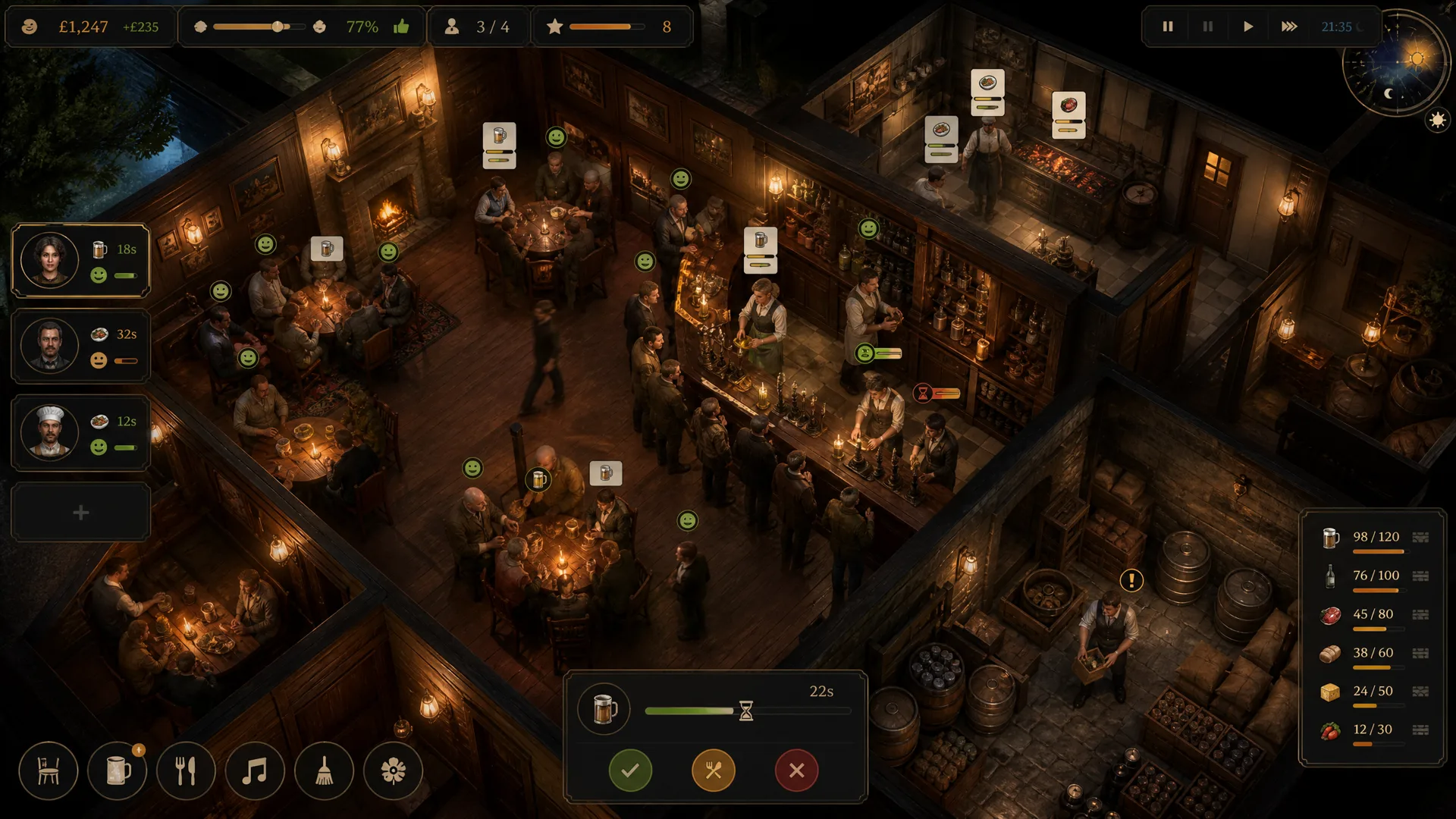
The visual presentation is instantly charming, utilising a crisp, detailed isometric perspective that allows you to oversee your domain at a glance. The art direction leans heavily into the quintessential aesthetics of British pubs, complete with patterned carpets, polished mahogany bars, and obscure local memorabilia. The warm, amber glow of the interior contrasts beautifully with the cold, rain-slicked pavements visible through the front windows.
Level design is intrinsically linked to the gameplay challenge. Each pub features a unique layout that forces you to adapt your strategies. A narrow bar might make it difficult for staff to pass one another during busy periods, while a sprawling beer garden introduces long travel times for table service. You are constantly making micro-decisions about furniture placement, trying to optimise the flow of foot traffic without compromising the cosy charm.
Choreographing the Chaos
The beating heart of your operation is your staff, and managing them is where the mechanical depth becomes apparent. You are responsible for hiring, training, and assigning roles to a diverse cast of characters, each with their own strengths and energy levels. A charismatic but slow bartender might be perfect for a quiet Tuesday, but they will quickly become a bottleneck during a Saturday surge. Learning to balance your rota is the key to maintaining a smooth service.
The control scheme is elegantly designed to handle this complexity. With a few intuitive clicks, you can reassign a struggling waiter to collect glasses, or pull a manager onto the bar to help clear a backlog of orders. The game provides clear visual feedback on staff stress levels and task queues, allowing you to anticipate problems before they escalate.
Service timing is everything. Customers have varying levels of patience, and a delayed order can trigger a cascading failure across the pub. If a table waits too long, their satisfaction plummets, affecting their likelihood to return. The tension of watching a complex round of drinks being prepared while a queue forms at the bar captures the frantic plate-spinning that defines peak hospitality hours.
The Engine Room: Kitchens and Cellars
While the bar is the public face of your pub, the cellar and kitchen represent the hidden engine room. Cellar management is an intricate mini-game in its own right. You must monitor stock levels, predict demand for different ales, and physically manage the changing of kegs. If a popular pale ale runs out mid-shift, you must manually intervene, sacrificing valuable time on the floor to keep the taps flowing.
The kitchen operates on a similar principle of supply and demand, adding another layer of logistical complexity. Coordinating food orders with drink service requires careful timing. A perfectly poured pint is of little use if the accompanying fish and chips take another twenty minutes to arrive. You must ensure that your chefs are adequately supplied with ingredients and upgrade equipment to handle larger volumes.
The Pacing of Pints
Managing queues and table satisfaction forms the core gameplay loop, requiring constant vigilance. As your reputation grows, the footfall transforms your quaint local into a bustling hotspot. The game introduces various customer archetypes, from patient regulars to demanding tourists. Identifying these groups and prioritising them is crucial for maintaining a high satisfaction rating.
Table management is particularly challenging. You must balance the need to turn tables quickly to maximise profit with the desire to let customers linger. A group that feels rushed will leave a poor review, while a table that is ignored will walk out. The UI overlay highlights table moods, allowing you to deploy staff strategically to placate disgruntled patrons with a complimentary bowl of crisps.
Community Economics
Beyond daily operations, the game introduces a fascinating macro-layer of pricing and neighbourhood events. The economy of your pub is in your hands, allowing you to adjust the price of every item. The local demographic dictates what they are willing to pay; overcharge in a working-class neighbourhood, and your pub will quickly empty out.
Neighbourhood events inject a welcome dose of unpredictability. A local football match might result in a sudden influx of rowdy fans demanding cheap pints, while a nearby theatre production could bring in a sophisticated crowd looking for premium wines. Adapting your menu, pricing, and staffing levels to accommodate these events is essential.
These mechanics ground the simulation in a believable world. Your pub is a vital part of a wider community, subject to the whims of the local economy. Here are some key factors to consider:
- Adjusting pricing tiers to match shifting local demographics.
- Stocking specific regional ales to appease vocal regulars.
- Managing the logistical strain of scheduled community events.
- Handling unexpected disruptions, such as a rival pub opening nearby.
Smooth Service
From a technical standpoint, Crown & Kettle delivers a remarkably smooth experience. The proprietary engine handles the complex simulation logic and dense crowds with ease, maintaining a consistent frame rate even during chaotic Friday night rushes. Pathfinding is generally excellent, with staff and customers navigating crowded spaces intelligently.
The developers have prioritised accessibility, offering a robust suite of options. The UI is clean, scalable, and entirely remappable, ensuring the wealth of information is never overwhelming. Colourblind modes are implemented thoughtfully, altering the subtle visual cues used to indicate customer satisfaction and staff stress.
Last Orders
Crown & Kettle is a triumphant entry into the management simulation genre, offering an engaging and authentic portrayal of British pub culture. It successfully balances the intricate logic of business management with the chaotic human element of hospitality. The variety of systems at play ensures that the gameplay remains fresh throughout the lengthy campaign.
While the learning curve can be steep when transitioning to larger venues, the game provides the tools necessary to master its complexities. The satisfaction of taking a rundown tavern and transforming it into a beloved local institution is immense, driven by a loop that rewards foresight and a cool head under pressure.