
Establishing the Foundation of Your First Wing
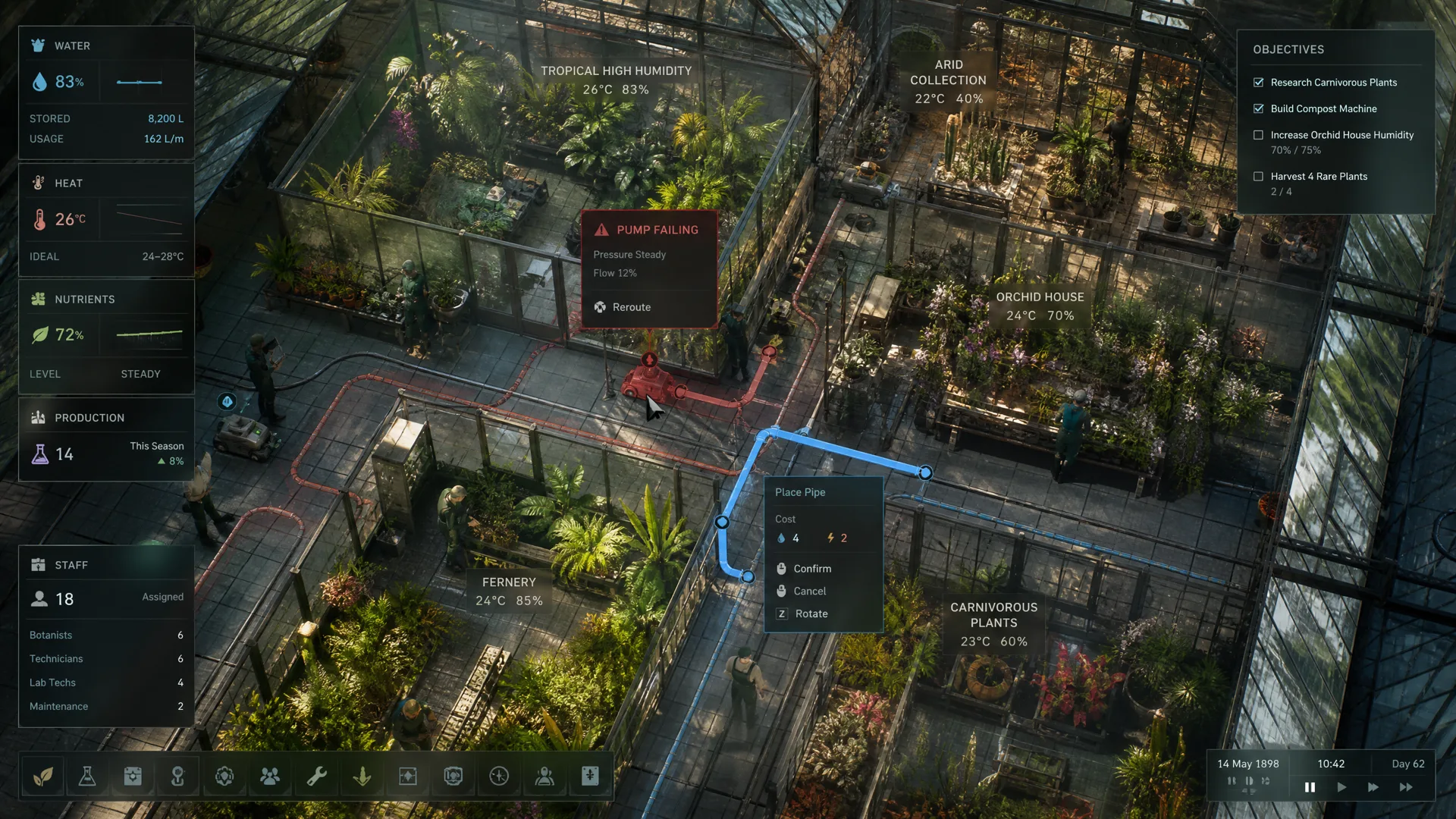
The isometric perspective of Greenhouse No. 6 offers a pristine, grid-based view of what will soon become a sprawling botanical empire. As an automation and management simulation, the game demands precision from the outset. Your initial task is not merely planting seeds, but engineering an environment where fragile flora can thrive without constant manual intervention. Building a stable first wing requires a deep understanding of the spatial requirements and the delicate interplay between your primary resources.
Early on, the temptation to expand rapidly can lead to catastrophic bottlenecks. The game actively punishes haphazard construction by increasing the energy costs of disorganised layouts. Focus on securing a reliable energy grid before attempting to cultivate anything more demanding than the hardiest starter crops. The beauty of Greenhouse No. 6 lies in its intricate systems; learning to read the environmental overlays for temperature and humidity is the first step toward true mastery. Taking the time to plan your initial grid will save countless hours of frantic retrofitting later in the campaign.
Mastering the Humid Zones
One of the defining mechanics in Greenhouse No. 6 is the creation and maintenance of distinct humid zones. Unlike simpler management simulators, this game requires you to compartmentalise your facility to cater to specific botanical needs. A humid zone is not a static buff; it is a dynamic ecosystem that fluctuates based on ambient temperature, foliage density, and the efficiency of your ventilation systems. Balancing these factors is a constant juggling act, particularly when attempting to house species with conflicting requirements in close proximity.
To establish a stable humid zone, players must invest in high-grade moisture retainers and strategically place atmospheric regulators. The game’s interface provides excellent visual feedback, with subtle condensation effects on the glass indicating optimal saturation levels. However, over-saturating a zone is just as dangerous as letting it dry out, leading to fungal outbreaks that can decimate a crop in minutes.
Furthermore, the placement of these zones dictates the flow of your entire facility. Grouping high-humidity areas together reduces the strain on your water pumps, but increases the risk of cross-contamination if a pathogen is introduced. The strategic depth here is remarkable, forcing players to constantly re-evaluate their spatial organisation.
Irrigation Networks and Nutrient Delivery
Water is the lifeblood of any botanical enterprise, and the irrigation mechanics in Greenhouse No. 6 are suitably complex. The system goes far beyond simply connecting a pipe from a water source to a plant bed. Players must manage water pressure, filtration, and the precise mixture of nutrients required by different crops. The nutrient mixing vats are a puzzle in themselves, requiring precise calibration to ensure that the delicate root systems of your most valuable plants are not burned by an overly acidic solution.
Designing an efficient irrigation network requires a keen understanding of fluid dynamics as presented within the game's engine. Gravity plays a crucial role; placing your primary water towers on elevated terrain significantly reduces the energy required by your pumping stations. The inclusion of nutrient injectors along the pipeline allows for localised feeding schedules, ensuring that a single water source can support a diverse range of flora.
Deploying Workers and Robotic Carts
While automation is the ultimate goal, the early hours of Greenhouse No. 6 rely heavily on human workers. Managing this workforce involves balancing their stamina, morale, and the sheer physical distance they must cover. Assigning tasks efficiently is paramount; having a worker traverse the entire length of the greenhouse to harvest a single crop is a massive waste of resources. The game encourages the creation of localised break rooms and tool sheds to minimise transit time and maximise productivity.
As your facility expands, robotic carts become available. These automated marvels are the key to scaling your operation. They navigate the narrow aisles between planting beds, transporting harvested goods to the processing centre or delivering heavy sacks of specialised soil. However, they are entirely dependent on the pathways you design.
- Designate one-way transit lanes to prevent robotic cart collisions.
- Place charging stations at equidistant intervals to avoid mid-task power failures.
- Assign human workers exclusively to delicate tasks, such as pruning and cross-pollination.
Cultivating Rare and Demanding Plants
The true test of your management skills comes with the introduction of rare plants. These exotic specimens are the primary source of late-game revenue, but their requirements are punishingly strict. Some require near-freezing temperatures during the night cycle, while others demand a specific wavelength of artificial light. Cultivating these plants forces players to push their environmental control systems to the absolute limit, often requiring dedicated, isolated chambers with redundant backup systems.
The challenge lies not just in keeping them alive, but in coaxing them to yield their valuable byproducts. The thrill of successfully harvesting a perfectly cultivated rare specimen is immense, serving as a powerful validation of your intricate logistical planning and environmental engineering. Fulfilling contracts for fictional botanical societies requires significant foresight and a willingness to completely overhaul existing sections of your greenhouse.
Balancing Production Schedules and Energy Use
Underpinning the entire botanical operation is a ruthless energy economy. Every pump, light, and atmospheric regulator draws power from your central grid. As your greenhouse expands, the energy demands skyrocket, forcing players to constantly upgrade their power generation facilities or face rolling blackouts. Managing this energy consumption is intrinsically linked to your production schedules.
The game demands that you schedule your most energy-intensive tasks during off-peak hours. This might mean setting your robotic carts to harvest and transport goods during the night cycle, or staggering the irrigation schedules so that all pumps are not firing simultaneously. Mastering the complex production schedule interface is essential for maintaining profitability in the face of ever-increasing maintenance costs.
Mitigating the Crisis of Failing Pumps
No simulation is complete without a healthy dose of chaos, and in Greenhouse No. 6, this often comes in the form of failing water pumps. Equipment degradation is a constant threat, and ignoring maintenance schedules will inevitably lead to catastrophic mechanical failures. When a primary irrigation pump fails, the clock starts ticking. The affected humid zones will rapidly dry out, and delicate crops will begin to wither within minutes.
Dealing with these crises requires a calm and methodical approach. Players must quickly reroute water from secondary reservoirs, overriding the automated systems to manually direct the flow to the most critical areas. This emergency management tests your knowledge of your own infrastructure. The decision of when to invest in backup pumps versus expanding your production capacity is a constant source of tension.
Conclusion: Achieving a Stable Ecosystem
Building a stable first wing in Greenhouse No. 6 is a monumental achievement that sets the stage for the rest of the campaign. It is a process that requires patience, foresight, and a willingness to learn from inevitable failures. The game's isometric perspective provides a beautiful, clinical view of your growing empire, while the deep, interconnected mechanics ensure that there is always a new challenge on the horizon.
The satisfaction derived from watching your carefully planned systems operate in perfect harmony is unparalleled. From the precise mixture of nutrients to the silent efficiency of the robotic carts, every element of the simulation works together to create a deeply engaging experience.